Showing posts with label recipes. Show all posts

Sunday, 3 November 2013

Pumpkins and bakes


So we have seen the Bake off final and I have harvested
4 pumpkins, 3 acorn squash and yet more yellow patty pans.

I made Green tomato chutney (from the latest Jamie magazine) which was great.

On the other hand my stuffed squash was not 100% successful. In fact not even 50% successful. I preferred the filling (60g Bulgar wheat with fridge veg)

I also made a lovely carrot, apple and courgette cake from the amazing Cake Hunter blog. It wasn't too sweet as uses honey, fruit juice and dates to sweeten it. It also had no eggs so quite heavy. You would definitely need the butter icing recommended but I screwed that up by using low fat cream cheese which dissolved into a pool that could never achieve frosting consistency. I admit I had to buy it in the end for office presentation.

I enjoyed it so much and colleagues liked it so much that I decided to bake it again for my own personal version of bake off - band of bakers. Yet again, I had trouble with frosting when practising.

On the plot I need to dig over the ground for winter and prepare soil - weed/ manure. STILL NOT DONE despite perfect weather - will have to wait until end November

In the recent storms, which we were lucky enough to miss the worst of, we just lost 2 fence panels. They will add fuel to the great allotment bonfire I am planning.

Finally with one of the pumpkins I roasted slices with whole onions and blitzed them for soup and also made Hugh Fearnley Wittingstall's pumpkin, chili cornbread which was a huge success.

Wednesday, 19 December 2012

December update


The end of the year is nearly here and I decided to inspect the damage caused by my neglect on the plot.

I was pleased to see that overall it was not too bad but in no way is the tidiness as good as Bernie’s which is dug and covered already. On my plot, a few hopeful weeds are clinging on and I need to tidy up generally. The manure I spread around the raspberries seems to be keeping weeds down but still needs hand weeding to get on top of any sneaky dandelions.

My own compost bins should be almost ready (she writes hopefully) and spreading that around once I've turned the soil should help nourish the earth and keep weeds down (unless it activates weed seeds that have been lurking in the compost). I can't see the likelihood of getting any help with that back breaking job.

I noticed we also had a massive pony poo delivery - I must nab a bit to mulch with. It should have rotted down by planting time. Not sure if I'll have time before Xmas though to transport it to the plot...

Mental note on general fertilisers: if you have rotted down root perennial weeds like bindweed and dandelions for fertiliser, don't forget and try to wash your hand in it at a later date. It is revoltingly stinky and it takes a lot of soap and hand gel to shift the lingering stench.

Looking around other plots, it looks like others seem to have put chard seedlings in. Too late for me. At least I have 3 PSB seedlings/ plants established. Admittedly this is a bad return on the 20 or so plug plants I started with but the way I see it these are strongest by natural selection.

I should have covered PSB as they have suffered pigeon damage. Maybe I’ll do it now (or after xmas) so they have time to recover in spring.

While it looks like rosemary is the only useable thing in the plot actually the Jerusalem artichoke is ready. I will leave in the ground until I’m able to use it as they go wrinkly quickly. Never the prettiest of veg, wrinkles don't enhance things.

I decided to try out a Jamie Oliver recipe:
2 handfuls of large Jerusalem artichokes or new potatoes
1 radicchio or treviso, outer leaves discarded (I left this out as I don’t like the bitterness)
3 little gem lettuces, leaves washed, dried and stalks removed
a small handful of fresh flat-leaf parsley or chervil, leaves picked and finely sliced
extra virgin olive oil
8 rashers thickly sliced smoked streaky bacon or pancetta
1 small red onion, peeled and finely sliced
3 tablespoons balsamic vinegar


Scrub the Jerusalem artichokes and boil them in salted water until tender. Once cool, cut them in half and set aside. Wash and dry salad leaves in a salad spinner.
Cut your bacon into slices and fry it. Add the sliced onion and the Jerusalem artichokes. Fry on a medium heat until the bacon is golden and crisp, the onion is sticky and soft and the Jerusalem artichokes have sucked up all the flavours and turned crispy.
Divide half the contents between four plates, then add 5 tablespoons of olive oil and balsamic vinegar to the pan, with a little pinch of salt and pepper. Mix everything together so the flavours improve and then pour immediately over the salad leaves waiting in the bowl. Toss lightly and quickly.
Incidentally the rosemary sprigs made pretty festive flourishes for the Christmas table

In other cooking news, I made Trucklements relish with shop bought beetroot and horseradish (bought in chapel market). Not quite in the grow your own spirit but delicious. You can find the recipe here


Monday, 24 September 2012

Harvest festival

This is cheating slightly as the apples that are the main ingredient in this recipe were not grown in my garden but they were given to me by a colleague and it's a great way of using cooking apples. It's even a little healthy I like to think as it has yoghurt in.
Natalia's Apple tray bake cake
1 cup yoghurt
1 tsp bicarbonate of soda
1/2 cup sugar
2 eggs
1 cup flour
2 cooking apples, chopped
1 tsp cinnamon

Mix yoghurt with the bicarb of soda and then all the rest - the dough will look really sticky. Add the apples and add the cinnamon. should have more apples than dough. Pour into a brownie tin and cook for 160 degrees for 30-40 minutes.

The second set of potatoes did OK but I only harvested 3.3kg from the 8 or so seed potatoes. In comparison with last year's haul 2012 has not been a stellar year. I suppose I could have left them in longer but the slugs had already got started on themand the top growth was less than perky looking.

I also harvested 950g of rhubarb which I was going to make apple and rhubarb jam but unfortunately I burnt the jam by leaving it on the heat too long while I was focussing on sterilising the jars. Now I have sterile jars but no jam. Damn.

I have 4 more beetroot which I roasted and will make beetroot houmous with using a Nigella recipe (below but with sesame seeds substituted for cumin which is verboten in our house because it's horrid) though I am also partial to a Beetroot horseradish dip where you combine 250g of beetroot with 2 tbsp of horseradish and 100 ml of creme fraiche or yoghurt and blitz in the processor.
Ingredients
  • 400g Chickpeas in tin, drained.
  • 2-4 fresh Beetroot, peeled & boiled until soft.
  • 2-4 cloves Garlic, crushed or chopped
  • Juice of 1 Lemon
  • 90ml Olive Oil
  • 1 teaspoon fine sesame seeds
  • 1/4 Cup Tahini (optional)

As a final fling the yellow courgettes have done me proud (ish).  I gathered 2.5kg of yellow courgettes including one that got out of control -1.7kg alone.  I'm not sure yet what to do with these monsters (along with a gifted marrow). Thoughts on a postcard please.  Maybe Nigella's courgette and raisin pasta...

The butternut squash look promising and I planted some Charlotte seed potatoes by the Jerusalem artichokes as an experiment. Even if there is no sign of growth I will leave tehm in for an early start next spring. Broad beans were sown in the potato area and deep rooted weeds dug up (mainly). A productive session.


Monday, 3 September 2012

The wrath of grapes?

At the weekend I cut back the grape vines which had got totally out of hand. They were so overgrown I couldn't even see the compost bins (even if I was really looking hard for them which I wasn't). 

This manic moment of pruning (well, butchering) revealed many but tiny bunches of green grapes below.  This made me think how clever people are and that there is a marvellously clever symbiosis of using grape leaves as wraps for food when there is a surplus of leaves once you cut back the branches to allow sunlight to ripen the grapes underneath. which then get made into wine (in places like Greece where they actually have sunshine - I just get dark red bullets). 

I have saved the largest leaves and will be making Quorn dolma at home when I get around to it.
Quorn/ beef dolma
Ingredients
  • Dolmades
  • 2 cups short grain rice, washed
  • 3 cloves garlic, crushed
  • 2 tbsp pine nuts, toasted
  • 1 onion, finely chopped
  • 1 small red capsicum, char grilled, skin removed and finely chopped
  • 1 small aubergine, sliced and grilled then diced
  • 50g currants
  • 3-4 eggs
  • Fresh black pepper to taste
  • 1 tbsp dried oregano
  • 3 lemons, (1 cut into slices and 2 made into juice)
  • 3-4 tbsp olive oil
  • 3 tbsp chopped fresh dill
  • 200g vine leaves, approximately depending on the size of the vine leaves, approximately 70-80
  • Lemon, garlic dipping sauce:
  • Juice and zest of 1 lemon
  • 1 clove of garlic finely minced
  • 125g low fat natural yoghurt
Method
For the dolmades: wash the rice well and drain well. Bring to boil 3 cups of water and add rice and stir until boiling, reduce heat to very low and place lid on. Cook for 15 minutes then turn off the heat and let the pot stand for 10 minutes. Do not lift the lid.
Tip the rice out into a bowl and add the minced garlic, onion, red capsicum, eggplant, currants, pine nuts, oregano, and dill and combine gently, add 1 egg at a time and gently combine keep adding eggs until the rice hold together when you squeeze it into a ball, season with pepper.
Wash the vine leaves well if using packaged ones, leave soaking in clean cold water while you use them.
Take 1 vine leaf and place it on a board, shiny side down and add teaspoon of mix and roll into a small cigar shape folding in the sides as you go. Place then in a steamer, seam side down and pack them tightly together and steam them until cooked about 20-30 minutes, once cooked place them in a flat bottomed container with a lid and add sliced lemons and lemon juice and pour over olive oil, let marinate.
For the lemon garlic dipping sauce: Mix ingredients together in a bowl.
To serve: Remove dolmades from marinade, serve cold with dipping sauce.
Nutritional Analysis (average per 135g)
  
Energy863kJ,
Protein5.6g
Fat8.0g
Saturated fat1.2g
Carbohydrate26.7g
Sugars4.7g
Dietary fibre2.5g
Sodium320mg

A happy accident
Unfortunately I cut off the growing tips of a few Jerusalem artichokes in my over-enthusiasm of cutting. Luckily , it turns out that was the right thing to do - as was ignoring watering them! (though I still worry that the grape vines created a situation of extreme drought).This is the advice from RHS:

When stems are around 30cm (12in) tall, draw soil around them to a depth of 30cm 15cm (6in) to help stabilise plants as they grow. Cut back stems (including flowerheads) to around 1.5m (5ft) in midsummer so plants won’t be rocked by the wind, thus avoiding the need for staking. Only water in cases of severe drought.  When foliage starts to turn yellow in autumn, prune to leave 8cm (3in) stumps above ground level. Place the prunings over plants to keep the soil warm and aid lifting of tubers in frosty weather.

Now I just have to pick up all the debris, turn the compost, plant the potatoes, sow the broad beans and beetroot.  Easy.

Tuesday, 21 August 2012

Medal winning plots?

While Team GB may have won a record haul of medals the plots of Great Britain are unlikely to have flourished in the sporadic weather. Or certainly judging by my plot.

People generally seem to agree that this has been one of the worst summers on record and we are seeing productivity way down on previous years. There is very little happening on the plot at the moment but all is not lost - I planted purple sprouting broccoli seedlings (16x Extra Early Rudolph plants from Marshalls) and more potatoes (some of which have already curled up and died) and will plant my living salad (mustards which survive colder weather better and don't bolt) at the weekend.

I cut down the old wood of the raspberries and saw that the grape vines are hugely overgrown - time soon for a trim and some dolma (stuffed vine leaves) soon.

Keep on top of weeds and check your potatoes that are in storage. I had an unpleasant and stinky experience with an exploding one - most unpleasant!  Keep them dry and in the cool but allow them to breathe.

The courgettes are still under attack but 2 beautiful yellow monsters appeared when I wasn't looking.
Cut them into thin slices, griddle, serve with feta, toasted pine nuts and mint. (The BBC recipe also says chili but I wimped out). It's a really delicious, fresh and summery dish - great as a starter or main depending on how greedy you are.


Monday, 21 May 2012

And it keeps on coming

Finally the rains seem to be on their way out and the weekend was dry enough to visit the allotment and do something useful. I weeded a bit and harvested an elephant garlic early. Not a bad size but very stinky to wander around the supermarket with.

I planted the borlotti beans, butternut squash, White sprouting broccoli and mystery tomatoes. I also bought a black cherry tomato at brockley Market so that is the only named variety I can identify for sure. As the plot seems to be a nursery for snails I hope they all make it.

The rhubarb seems to be calming down a little but I was still able to harvest 880g of rhubarb. I decided to try a new recipe - rhubarb clafoutis from River Cottage Everyday.

Rhubarb Clafoutis
from Hugh Fearnley-Whittingstall, River Cottage Every Day
serves 6 (but that's generous portions each)
550g rhubarb
a pinch of cinnamon
grated zest of 1/2 orange and the juice of the whole fruit
110g sugar
50g plain flour
a pinch of sea salt
3 eggs lightly beaten
1 cup whole milk
Preheat the oven to 200degrees. Cut the rhubarb into 2-inch lengths and put it into a baking pan with the cinnamon, orange juice, and 2 tablespoons sugar. Toss well, and roast for 20 minutes until just starting to caramelize. Let it cool, and drain it in a sieve.

Turn the oven down to 180 degrees. Butter a 25cm round baking dish or springform. Arrange the rhubarb on the bottom of the dish.

Sift the flour and salt into a bowl and stir in the sugar. Make a well in the center and add the beaten eggs. Stir the flour into the eggs, and then whisk in the milk a little at a time.
Pour the batter over the rhubarb and bake for 35 to 40 minutes, until the clafoutis is golden and puffed. Serve warm or cold, with icing sugar to top.

So that's breakfast sorted for Tom all week then.


Monday, 30 April 2012

Foraging in your own back garden

The other day we made a rather unusual discovery in our shaded vegetable patch at home. Firstly I know a shaded veg patch isn't ideal - it was the result of bad planning on my part when we erected a trellis fence half way down the garden and sited the veg beds immediately behind it in its shade. Oops. The area is also overlooked by trees but is hardly a woodland glade where one would expect to find what we found. But enough teasing...

We found a large growth looking a little like an alien brain. It was clearly a fungus but was it edible? Consultation with some eastern European colleagues who professed to be more in tune with the land and self sufficiency (despite being transplanted to this metropolis) yielded ominous results.

They declared it best to steer clear and they didn't recognise it from the perhaps vague photos sent through by Tom.

However I had a hunch. A hunch that we had a prized morel in our back yard. Online research showed morels to look similarly pitted and to have a hollow stem. There are false morels which are poisonous but they have solid insides. With trepidation we cut open the growth and to our delight it was hollow.
The next challenge was how to eat it. After worried enquiries by my mother when I told her we were about to eat an almost identified mushroom, we quickly checked where the nearest A&E was (Lewisham I believe). We went for one of 10 easy morel recipes - mushroom and butter pasta. Chopped and added to sweet sweated onions and garlic in butter and served with angel hair spaghetti made for a wonderful meal. Delicious and we are still here to tell the tale.

A word of warning: Do be very careful when identifying mushrooms and if in doubt leave it out.
Other foraged foods that could be found pretty easily are wild garlic (ransoms) and nettles. As usual avoid plants near paths and busy roads to avoid exhaust fume pollution and "doggy messages".


Wednesday, 25 April 2012

Rhubarb rhubarb (and chard)


Chard stalks before being blanched
Before the deluges came I harvested a vast harvest of rhubarb and chard. With 2kg of rhubarb and 1.612kg of chard I had to get out all the recipe books to use up the bounty. I made three dishes with each so it's been a week of rhubarb and chard for us.

The recipes were:
- Rhubarb and cinnamon cake for Riverford Farm Everyday and Sunday cook book
http://www.amazon.co.uk/Everyday-Sunday-Riverford-Farm/dp/0007388268/ref=sr_1_2?ie=UTF8&qid=1335172840&sr=8-2#reader_0007388268
It comes out a little 'puddingy' - I like to call it moist (apart from hating that word).
60g unsalted butter
380g sugar
3 large eggs
drops vanilla extract
300g self raising flour
1 tsp bicarb of soda
1 tsp cinnamon
250ml creme fraiche (I used used up left over custard and 0% fat Greek yoghurt)
450g rhubarb cut into 1cm pieces
Rhubarb cinnamon cake
Oven at 160 degrees. Cream the butter and sugar together. Add eggs, vanilla. Add flour (sifted if you can be bothered - I couldn't), bicarb and cinnamon, fold through creme fraiche and rhubarb. Cook for 40-50 mins until skewer comes out clean.
- Rhubarb and custard cake where they advise using ready made custard - I used more than the recommended quantity but then I also used a low fat version.
Rhubarb and custard cake
- Pickled rhubarb. This is something I first tasted at Mike and Ollie's supper club in Deptford and it was great with mackerel. I liked it so much I got the recipe and here it is in Mike's own words "Boil together cider vinegar, 1/4 of the vinegars volume in sugar, a few bay leaves and juniper berries. Pour over chopped and cleaned rhubarb and hey presto! It will keep for some time."
Chard gratin
- Chard gratin using stalks. Basically layers of blanched chard stalks (save leaves for the 'risotto' below. Top with a reduced tomato sauce (mine was left over from a pasta). Mix chopped onion and garlic into creamy mix, with cream cheese and 0% Greek yoghurt. Finally top with breadcrumb mixed with Parmesan. Pop into the oven for a bit until browned on top.
- Chard stalks and anchovy mix, served with pasta. Essentially chopped blanched stalks mixed with melted butter, garlic and a few anchovy fillets. From 'Vegetables from an Italian Garden' http://www.amazon.co.uk/Vegetables-Italian-Garden-Season---Season/dp/0714860808/ref=sr_1_1?s=books&ie=UTF8&qid=1335173364&sr=1-1
Chard 'risotto' with barley
- I used the left over chopped chard leaves in a pearl barley 'risotto' (I think it's called orsetto in Italian) inspired the latest series of Two Greedy Italians. Here they made it with pork mince but I kept it veggie and substituted chard for spinach. http://www.bbc.co.uk/food/recipes/pearl_barley_with_21752

The rain has limited my planting plans but in fear of running out of space at home I scraped a trench into the plot with a hoe and plopped the pea seedlings into it and left them to the garden gods. I must remember to provide pea sticks for support but they will have to muddle through for the moment. I also created a little line of beetroot seedlings on the garlic onion borders.
Apparently I can't harvest the onions and garlic until early to mid Summer. The internet informs me that this is probably June at the earliest. Perhaps I can care for the tomato and courgette seedlings long enough to delay planting them out till June?

Monday, 12 March 2012

Spring has sprung

The blossom has just opened up on the plum tree in the garden and the blueberries are coming into leaf.

Temperatures are averaging 15 degrees and the weeds (sadly) are springing back to life. (Note to self: hoe between garlic, onions, shallots etc. which are looking a touch jungle like).

Though the saying goes "ne'er cast a clout till May be out" (see the excellent phrases.org.uk to learn more about the phase) implies we shouldn't discard our winter clothes till May (or indeed till Hawthorn (also called May) is in bloom) weeds actually start back into life from 7 degrees so keep a vigilant eye open and a hoe ready.
With the joys of spring growing within me and limited chances to sow seed, I made a mad dash before a flight on the 10th to plant some of the potatoes I have had chitting in the kitchen.  In went the first earlies and a couple of Shetland Blacks.  I had dug 4 trenches and I filled 3 of them (30cm or a foot's length separating them and in the pit not top of the piles and gently firmed up the soil above them) in this order:
- trench nearest plank pile: Sharp's Express PLUS Shetland Black x 2
- middle trench: Swift
- 3rd trench from plank pile: Pentland Javelin

That leaves one more one more trench which I shall save for the rest of the Shetland Black x 4 and the British Queen. Though I also have Ratte chitting madly so they will need a home.  I have 3 patio potato planters which I think I will use for Charlotte and Ratte. The compost is already waiting by the kitchen steps though I plan to stagger the planting of these to see if I can spread the inundation of spuds.

Delicious magazine (April edition) have got 6 lovely sounding recipes for use with Jersey Royals so I might use the last of the stored potatoes for chips, tartiflette and sauteed but paired with Chorizo rather than black pudding.
Jersey Royal chips with Saffron Aioli - 500g potatoes sliced lengthways in quarters, cook in boiling water 3-4 minutes, toss with 2tbsp olive oil, roast 30-40 minutes till crispy + cheat's aioli (thanks to Donal Skehan) 3tbsp mayonnaise, 1tbsp lemon juice, 1 tsp Dijon mustard, 1 chopped garlic clove
Jersey Royals with anchovy gremolata - finely mince 1 garlic clove, zest of 1 lemon, parsley, toss with potatoes, 25g butter, 2 sanchovy fillets finely chopped.
Jersey Royal and fontina frittata
Jersey Royal salad with hot-smoked salmon, dill and mustard creme fraiche - 4 tbsp creme fraiche, 2 tbsp olive oil, squeeze lemon, 1tsp Dijon mustard
Tartiflette
Sauteed Jersey Royals with black pudding and fried egg

According to the books this si the time to be planting jerusalem artichokes so it is also time to harvest the last of them (leaving a few behind int he ground for next year).

I intend to use another recipe from Delicious magazine for Mother's Day: Jerusalem artichoke and potato bake with welsh rarebit topping. Considering that the last 2 plants I dug up yielded 1.9kg I may need to consider making a Jerusalem Artichoke Flan too (from the excellent BBC website).


Monday, 27 February 2012

Delicious ideas to borrow from a pop up restaurant

Now, I know that pop up restaurants were very fashionable and it has become almost as fashionable to knock them but I have come to them late. When I say them, I actually mean just one that has started in the last month in Deptford, Mike and Ollie. They have been serving up wonderful concoctions at Deptford and Brockley markets and have now introduced a supper club element.

Quite apart from being delicious and a great way to meet like-minded locals, it was also a source of inspiration for future home cooking sessions.

The pickled quince was delicious served with pork belly on toast and I intend to recreate it using Nigel Slater's recipe if I can find quinces easily enough at this time of year - they were foraged by Mike in Crystal Palace before Christmas I believe.

Enough for 2 medium-sized storage jars.
750ml cider vinegar
400g golden granulated sugar
3 medium-sized quinces or 4 smaller ones
12 juniper berries
8 black peppercorns
a bay leaf
Pour the vinegar into a stainless-steel pan. Add the golden sugar, juniper berries, black peppercorns and bay leaf and bring to the boil. Turn the heat down to a merry simmer.
Peel, halve and core the quinces, cutting them into six lengthways. Lower the quince into the simmering vinegar and leave the fruit to cook for 15-25 minutes, until it is soft enough to pierce effortlessly with a skewer.
Lift the soft fruits out with a draining spoon and lower them into clean storage jars. Pour over the liquor, then seal and leave to cool. They will keep for several weeks.

Another revelation was pickled rhubard with mackerel. These were whole forced rhubard stalks and their tartness were delicious, off setting the salty fatty taste of the mackerel.  I shall try this recipe from www.platethrive.com  which seems to offer the best combination of sweet and sour:

Ingredients
• 1 1/4 cups apple cider vinegar (I suggest using raw and unpasteurized apple cider vinegar, such as those by Bragg’s or Eden Organic)
• ¾ cup filtered water
• 1 cup maple syrup or honey
• 1 ¼ – 1 ½ pound rhubarb, thin stalks if possible (about 1/2-inch thick)
• 1 ½ inches peeled ginger root, peeled and thinly sliced
• 1 tsp whole cloves
• 1 tsp whole allspice berries
• 1 tsp whole fennel seeds
• 2 cinnamon sticks
• 4 dry chili peppers


Directions
  1. Place vinegar, water, and maple syrup/honey in a saucepan over medium heat. While mixture heats, cut rhubarb stalks into lengths that fit inside the jar with approximately 1-inch headspace (about 4-inches long if using a pint jar). If your rhubarb stalks are much thicker, slice them in half or quarters so they are about 1/2-inch x 1/2-inch before cutting into 4-inch lengths. Set rhubarb aside.
  2. Divide cloves, allspice, and fennel between the jars. Then place rhubarb stalks inside, tucking sliced ginger, chili peppers, and cinnamon sticks between the stalks.
  3. Pour boiling vinegar mixture over rhubarb until jars are full, leaving about ½-inch headspace and making sure rhubarb stalks are fully covered. If you have leftover brine, save to use for salad dressings or other pickling projects. Screw on jar tops and let cool on kitchen counter until approximately room temperature. Then place in the refrigerator. For best flavor, let sit for 1-2 weeks before consuming.
makes about 2 pints or 1 quart

Chutneys, pickles and all that jazz

Despite having many preserves in the cupboard and not getting through them fast enough I have still been indulging in a little pickling/ chutney making.

Spiced apple chutney was a real success paired with simple slow cooked (bone out) shoulder of pork. It provides a good balance of sharpness from the vinegar, sweetness from the fruit and spices from the... well you get the picture.

I used a recipe from Marguerite Patten's The Basic Basics Jams, Preserves and Chutneys
Here it is in its original form but I added a little more vinegar as I was worried it might end up being too apple sauce-y (also good but different):
Ingredients:
  • 450g chopped onions
  • 300ml white malt vinegar
  • 900g apples, peeled and cored and diced into 2cm inch dice
  • 1tsp mixed spice
  • 350g soft light brown sugar
  • 100g raisins
  • seasoning to taste
Simmer the onions in half the vinegar for 10 minutes, add the rest of the ingredients. Stir over a low heat until the sugar has dissolved and then simmer steadily, stirring occasionally until you have the consistency of thick jam. Check for seasoning, spoon into steralised jars and you’re good to go. I steralise my jars by microwaving them slightly damp in the microwave.

One learning I had was not use up the boozy fruit from making 'fruits of the forest' vodka (used a supermarket frozen bag) by putting them in a trifle. They are overwhelmingly vodka flavoured and make the dish inedible unless you like the taste of neat vodka. Boiling them up and creating a 'jus'/ 'compote' and hopefully burning off some of the booze may be a possible option.  I only hope the vodka tastes as much of fruit as the fruit tasted of vodka. Not a personal culinary success.
Lovely Rye on a gorgeous sunny 17 degree day
It is also time to crack open the beetroot chutney, paired with horesradish, mackerel and watercress. (We picked up a couple of mackerel in Rye which we visited for the Scallop festival - more a top billing on restaurant menus than a real festival but lovely none the less). The beetroot chutney should also work with goats cheese - the unpickled version being a classic combination.  Once back from Sicily, I feel a salmon, beetroot and goats cheese tart coming on...

Monday, 20 February 2012

Plotting for potatoes

Our potatoes are happily chitting - some more than others. The two packs from Poundland (Swift and Pentland Javelin) are racing away despite not being in the regulation egg trays (left over from duck egg folly at a great Asian foods wholesale shop). In fact their stalks may be too long and pale. The Charlotte, British Queen and Sharpes Express (from a friendly 99p shop - we have all the best stores in my area!) are doing ok - short and healthy stubs of growth.  The Shetland Blacks are the slowest and were gleaned from a local (amazing) farmer's market where there is a potato specialist. I believe they are not really black but dark purple. It's a heritage variety that is a second early and are floury in texture and so make excellent chips or roast potatoes. British Queen is also new to me and a heritage potato (1894 apparently) that is supposed to be good for mash.  Sharpes Express is another traditional first early (1901) - very floury texture if left to mature, when it is best baked. I am informed the yield suffers in dry weather so keep well watered. Must watch out in the upcoming drought.

I especially chose mainly first or second earlies as that allows me to clear plot and either try a second lot of potatoes (first earlies) for Xmas or put in another plant group (beetroot, french beans? I'll make up my mind later).

Anne Swithinbank suggests trying an early potato sowing in the February edition of Grow Your Own magazine. Apparently you create trenches, plant in the bottom of the trench and pile up the earth next to the trench (and use it to 'earth up' later on) and cover the trench with double layers of fleece to protect from frosts. Essentially the fleece is anchored to the top of the earth piles. Worth a go - maybe with the easier to source seed potatoes like Charlotte.

I decided to finally clear most of the stored potatoes at the weekend. Jansson's Temptation will feature again for supper (again with bacon instead of anchovy).

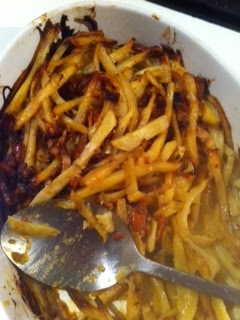
I have my friend Katie to thank for the inspiration for my layered lunch. Essentially it a is a potato terrine. You layer in a loaf tin sliced par boiled potatoes with any veg you have to hand - in my case blitzed Brussels sprouts with shallots and bacon bits and then pour 4 beaten eggs over it and cook at a lowish heat in the oven (I did 160 degrees).

Slice very thickly and it makes a filling healthy lunch.

Tuesday, 7 February 2012

Garden treasures

Despite PSB (purple sprouting broccoli) not working out for me this year (mainly due to labelling errors and then neglecting plug plants) I have still had some home grown broccoli. Or calabrese. 

According to www.allotment.org.uk the way you can tell the difference is not to go by supermarket labels which confuse matters. Apparently the main variable is that broccoli is an over wintered crop but calabrese produces its crop the same year before winter. and that the flavour of calabrese is milder and much preferred by many to sprouting broccoli and it is an easier crop to grow.

My versions are small and growing in the raised bed border where they were supposed to be adding a vibrant purple.  But that is the problem with mislabelling - heyho.

They have still been put to good use. I steamed and added the spears to a skinny minnie macaroni cheese from Cook Vegetarian magazine.  I couldn't find the exact recipe online for you but it isn't too different from this one. The one I made had more vegetables (carrots, leeks, onion, asparagus and peas) and less pasta - 175g. And the topping was grated parmesan (didn't have breadcrumbs to hand) though if you were really vegetarian you wouldn't use parmesan because it uses rennet (which is apparently something to do with cow intestines - oh yum)

Sunday, 29 January 2012

Keeping up with the seasons or the Jones's

I have an admission to make. I think we are in March despite it blatantly being the end of January.

Two factors have helped me in this delusion.

Firstly, we seem to be playing spot the winter this year. 2011 was the second warmest on record and while December is officially average, it certainly felt unusually warm with reports from around the country of daffodils blooming early and roses blooming late. Perhaps we were collectively comparing it with the previous December which was the coldest ever on records.

The other factor that is supporting my early spring fever is being connected to other gardeners. I buy a lot of gardening magazines. And by a lot, I mean all of them. I follow fellow gardeners online via twitter and I have countless reference books at home. The advantage magazines and online updates have is that they are timely reminders of what we should be doing and when. It is too easy to leave the books on the shelf when glossy pages demand your attention.

The problem is that magazines in particular are ahead of schedule.  February issues come out in early January and have tips and things to do now. I no longer know if they mean now, early January, or now, the February that is still a month away. 

This means I am always worried about being behind time, like the rabbit in Alice in Wonderland.  Luckily my inertia and other time pressures means that I am a month behind (or ahead depending on which month the tips are supposed to be for). So I still have to sow the broad beans and chillies and tie in the raspberries (and cut down a third of them to see if they are really autumn or summer varieties).


At least the potato resolution is going well - one mammoth cooking session later and we now have Sarah Raven's dauphinoise to look forward to and we have already tucked into a bastardised version of Hugh Fearnley-Whittingstall' Jansson's Temptation. This is made of matchsticks potatoes softened in a pan with onions then stirred with cream and anchovies and cooked for 45 minutes at 200 degrees.  As I didn't have cream or anchovies I used up some left over bacon bits, chorizo and skimmed milk instead and I can say it was delicious even if it wasn't up to the authentic Swedish dish.

Sunday, 9 October 2011

Taking a break

I have been on holiday. The neglect and mini Indian Summer while I was away combined with the previous wet, bad weather meant that crops stopped much earlier than last year.

On my return I decided it was time for a tidy up. I took up the beans (remembering to keep the nitrogen fixing roots in the earth) and, with the help of my friend Carole, weeded the plot.  Now all I need to do is shift (I did say shiFt) a load of manure that a local pony owner left and mulch the plot to prevent weeds from regrowing and to nourish the land.

Earlier this year I was forward thinking and, looking to future, I ordered purple broccoli plants.  Unfortunately they arrived just before I went on holiday and while I was away in Sicily they died when left out (unplanted - very wasteful Katrin) in the unexpected late sun.

In the mean time I have gone mad and bought a myriad of vegetable based cookery books:
- Verdura - vegetables Italian style by Viana La Place
- River Cottage Veg Everyday by Hugh Fernley-Wittingstall
- Vegetables From an Italian Garden by Phaidon deserves a special mention for being a simply beautiful book with special seasonal sections on growing vegetables too. A delight to look at.

I can't wait to try out some of the recipes.

Tuesday, 26 July 2011

Potato feasts

We are snowed under by potatoes.  Once again I forgot that we tend to prefer rice and pasta to potatoes.

After sorting the good unblemished potatoes by type and storing them in breathable canvas bags in the dark to stop them from turning green or sprouting I turned to the rejects.

These were either mainly scabby or damaged by a stray fork when lifting them though it also included some of the mystery spuds that popped up unasked for.

I prepared roast potatoes for freezing (par boil and freeze on a baking sheet to stop them from freezing in a clump) and pseudo oven chips (cut and bake until slightly turning colour - remember to use oil to prevent sticking which is something I forgot and resulted in a bit of a mess). I still had tiny potatoes that I didn't want to compost for fear of them reseeding but that were too small to peel. With these I made a potato salad loosely based on Lucas Hollweg's excellent German potato salad recipe from his recipe book 'Good Things to Eat'. I didn't remove the skins because it was too fiddly and I thought the fibre was good for me but I did crush them to allow the sauce to penetrate them and infuse them with flavour.  I used  my own puny garlic but supplemented with more.

Serves 4

- 750g waxy new potatoes, evenly sized
- 1 tbsp dijon mustard
- 2 tbsp red wine vinegar
- ½ tsp sugar
- 50ml mild olive oil (not extra virgin) - think I only used the olive oil (health again)
- 50ml vegetable oil
- 1 bunch of chives, chopped - I substituted with a clove of garlic and chopped shallot

Boil the potatoes in salted water for about 20 minutes until soft. Drain and leave to cool. Meanwhile, make the dressing by mixing together the dijon mustard, red wine vinegar, sugar and some salt and pepper in a bowl. Gradually beat in the oils. Mix with the crushed potatoes and leave for an hour or two for the flavours to become acquainted. Scatter chives over the top and dig in.

Since my trip to Germany I am also searching for my mother in law's version which seems to involve cream, pork fat and mustard and very slow cooking the potatoes.

Tidal waves of squash


Not orange squash that you drink but summer squashes that you eat. These include edible gourds, pumpkins and courgettes. There is a great variety and among my harvest I have collected striped, pale green and yellow courgettes.

The problem I now face is 'what to do with them all?'. If I weren't trying to be healthy I would definitely make courgette cake which is delicious and moist. But I am on a health kick so avoiding too much sugar.

I discovered a recipe in a free booklet from a cooking magazine: Quinoa, courgette, tomatoes and feta. Now I had neither tomatoes nor feta and rather than wait I improvised slightly. I mixed the 1tbsp of red wine vinegar and 2tbsp of olive oil in a pasta sauce jar so infusing it with tomato flavours and then stirred it through 75g of quinoa (a great protein source). The courgettes were finely sliced into ribbons and mixed in. As I had no tomatoes I used a little green tomato chutney from last year. Finally I chopped up a little Turkish cheese but unfortunately it is more like a waxy mozzarella than feta so I doubt it will add the right sort of crumbly saltiness. It's lunch today so hopefully is tasty.

At the same time I made courgette lasagne from the same booklet. It also serves 2.
2 courgettes grated
1 garlic clove (I used 2)
Parmesan grated
Lasagne sheets
100g ricotta
Jar of tomato pasta sauce
(I left out the chilli and substituted low fat yoghurt for the ricotta and strong cheddar for the Parmesan)

Fry the crushed garlic and grated courgette until soft. Add the ricotta and 2tbsp of Parmesan. Place 2tbsp of the mixture into a small dish, layer on a quarter of the tomato sauce, place pasta sheets on top then repeat until you run out. Make sure the top is tomato and sprinkle with cheese.

Sunday, 22 May 2011

Roast homegrown beetroot and feta salad

Tip: keep trying with different ways of preparing vegetables if you're not sure about them at first. This combination almost made beetroot acceptable to Tom.


I mean the beetroot was home grown not the feta. That's a whole different level of self-sufficiency.

Wrap the beetroot in foil and bake on a low heat.

Once soft to the touch peel if you want to (I kept skin on in hope of increasing healthy fibre content). Chop and toss with a mixed salad. Sprinkle with feta and seeds.

Make a dressing with blackcurrant jam, vinegar, chopped garlic and a touch of mustard gently heated together in a pan. Drizzle (or pour if greedy) over the salad. Hey presto - gastropub salad.

Monday, 18 April 2011

A quick and easy wholemeal broccoli lunch


I harvested another 1.26kg at the weekend. All great apart from the smell it gives off after a day or so and I defy anyone to cook more broccoli than me. I have done broccoli quiche, broccoli gratin and broccoli souffles and still I have lots left.

I plan to steam the best stalks and serve them with hollandaise sauce for Tom and lemon and anchovy for me (health kick still more or less holding).

This morning though I chucked together a very easy and speedy lunch which is not only healthy but helps to use up leftovers. Mix 100g cooked wholemeal pasta shapes with half a jar of cool salsa (spicy is fine if you must). Chop up the long broccoli stalks and briefly boil with the florets. Add to the pasta mix. Easypeasy. For those so inclined, add pepper and lemon. If I'd had more time I would have added anchovy and onions.

Wednesday, 6 April 2011

Broccoli, ham and cheese souffle


Twice baked souffles are a godsend to busy working people. Make them when you have a little time to spare and chill or freeze them till you need them again.

True, they aren't the billowy cushions of a once baked souffle is but they are practical and can be low fat.

This was based on a Weightwatchers recipe that has only 4 pro points in and is delicious.

You are supposed to use two eggs separated but I had two egg whites left over so just used them. The fact I didn't use the rich yolks meant I felt justified in adding a little mozzarella on top when they got cooked for the second time.

25g low fat spread
25g self raising flour
25g Parmesan
4 slices parma ham
225ml skimmed milk
1tbsp mustard
150g finely chopped broccoli

Grease 4 ramekins. Preheat the oven to 180 degrees.

Whip up the egg white. Melt the butter, remove from the heat and gradually add the flour so it becomes a smooth paste. Slowly add the milk, stirring all the time. Return to the heat and bring to the boil until it reduces slightly. Remove from the heat. Fold in the finely chopped raw broccoli, most of the Parmesan (save 2 tbsp for the topping) the chopped ham and some coarse mustard. Cook for 25 mins or until risen. Leave to cool.

When ready to serve, remove gently from ramekins and bake for another 20 mins. Serve on a bed of salad with a sharp dressing.