Showing posts with label Hugh Fearnley Wittingstall. Show all posts

Monday, 21 May 2012

And it keeps on coming

Finally the rains seem to be on their way out and the weekend was dry enough to visit the allotment and do something useful. I weeded a bit and harvested an elephant garlic early. Not a bad size but very stinky to wander around the supermarket with.

I planted the borlotti beans, butternut squash, White sprouting broccoli and mystery tomatoes. I also bought a black cherry tomato at brockley Market so that is the only named variety I can identify for sure. As the plot seems to be a nursery for snails I hope they all make it.

The rhubarb seems to be calming down a little but I was still able to harvest 880g of rhubarb. I decided to try a new recipe - rhubarb clafoutis from River Cottage Everyday.

Rhubarb Clafoutis
from Hugh Fearnley-Whittingstall, River Cottage Every Day
serves 6 (but that's generous portions each)
550g rhubarb
a pinch of cinnamon
grated zest of 1/2 orange and the juice of the whole fruit
110g sugar
50g plain flour
a pinch of sea salt
3 eggs lightly beaten
1 cup whole milk
Preheat the oven to 200degrees. Cut the rhubarb into 2-inch lengths and put it into a baking pan with the cinnamon, orange juice, and 2 tablespoons sugar. Toss well, and roast for 20 minutes until just starting to caramelize. Let it cool, and drain it in a sieve.

Turn the oven down to 180 degrees. Butter a 25cm round baking dish or springform. Arrange the rhubarb on the bottom of the dish.

Sift the flour and salt into a bowl and stir in the sugar. Make a well in the center and add the beaten eggs. Stir the flour into the eggs, and then whisk in the milk a little at a time.
Pour the batter over the rhubarb and bake for 35 to 40 minutes, until the clafoutis is golden and puffed. Serve warm or cold, with icing sugar to top.

So that's breakfast sorted for Tom all week then.


Sunday, 29 January 2012

Keeping up with the seasons or the Jones's

I have an admission to make. I think we are in March despite it blatantly being the end of January.

Two factors have helped me in this delusion.

Firstly, we seem to be playing spot the winter this year. 2011 was the second warmest on record and while December is officially average, it certainly felt unusually warm with reports from around the country of daffodils blooming early and roses blooming late. Perhaps we were collectively comparing it with the previous December which was the coldest ever on records.

The other factor that is supporting my early spring fever is being connected to other gardeners. I buy a lot of gardening magazines. And by a lot, I mean all of them. I follow fellow gardeners online via twitter and I have countless reference books at home. The advantage magazines and online updates have is that they are timely reminders of what we should be doing and when. It is too easy to leave the books on the shelf when glossy pages demand your attention.

The problem is that magazines in particular are ahead of schedule.  February issues come out in early January and have tips and things to do now. I no longer know if they mean now, early January, or now, the February that is still a month away. 

This means I am always worried about being behind time, like the rabbit in Alice in Wonderland.  Luckily my inertia and other time pressures means that I am a month behind (or ahead depending on which month the tips are supposed to be for). So I still have to sow the broad beans and chillies and tie in the raspberries (and cut down a third of them to see if they are really autumn or summer varieties).


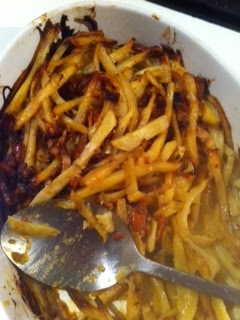
At least the potato resolution is going well - one mammoth cooking session later and we now have Sarah Raven's dauphinoise to look forward to and we have already tucked into a bastardised version of Hugh Fearnley-Whittingstall' Jansson's Temptation. This is made of matchsticks potatoes softened in a pan with onions then stirred with cream and anchovies and cooked for 45 minutes at 200 degrees.  As I didn't have cream or anchovies I used up some left over bacon bits, chorizo and skimmed milk instead and I can say it was delicious even if it wasn't up to the authentic Swedish dish.

Thursday, 19 August 2010

Saving the best to last

Top tip: Use vegetables as soon after picking as possible to keep nutrient levels up. If you can't eat them all immediately then blanch the vegetables to reduce harmful bacteria. Cooked tomatoes have higher levels of Lypocene which make them better at fighting heart disease and protect against cancer.

There is a saying that we are all either green and growing or we are ripe and rotten. This holds as true for fresh produce as it does for us.  Wine and cheese may get better with time and exposure to the air but this is rarely true for crops. Vegetables, like our skin, start to lose water and become flaccid as soon as they are picked. Why grow your own, only to neglect your crop once picked and eat vegetables that are no fresher than in the shops?

They also start to lose their vitamin content. The FAO (Food and Agriculture Organisation  of the UN) state that vitamin C content decreases with time after harvest, and that little may remain after two or three days. When you do cook the vegetables, bear in mind that overcooking means a significant drop of vitamin content - try steaming instead of boiling (also eat potato skins as their vitamins are just under the skin) and use the water in a stock as the dissolved minerals stay in the water.

It can be hard to eat all the vegetables fresh so it helps to have a few ways of processing them. Our new freezer arrives in three days and I can resume blanching duties (the existing two freezers are already full). In the meantime, I have got a free extra fridge (from Freecycle) to store jams and chutneys in.  I am particularly fond of Hugh Fearnley Wittingstall's recipe for 'Glutney'.

This is a great way to use up summer vegetables and you can just use whatever is taking over your plot at the time. The quantities he recommends make 10 jars so i halved everything here. I also kept out the chillis as I am a wimp. I also rarely have all the spice to make the spice bag so I just use some allspice and nutmeg.

500g courgettes, diced into 1cm
500g red or green tomatoes (I don't bother to skin them though it was recommended), roughly chopped
500g cooking or eating apples, peeled and diced
250g onions, peeled and diced
250g sultanas or raisins
250g brown sugar
375ml white wine or cider vinegar, made up to 500ml with water
1 thumb sized nugget of ginger roughly chopped
1 tsp of mixed spice
1/2 tsp of nutmeg
1 tsp mustard powder and 1/2 tsp salt

Put all the ingredients in a pan. Heat the mixture gently, stirring to dissolve the sugar, bring to the boil. simmer uncovered for 2-3 hours (this makes the kitchen smell great). Stir to make sure it doesn't burn. it's ready when rich, thick and reduced. Put while warn in sterilised jars. Leave to mature for 2 weeks, ideally 2 months, before serving.

This recipe is also a speedy way of using up cherry tomatoes that is surprisingly healthy - in fact I adapted it from a Weightwatchers recipe. It takes just 10 minutes to prepare and 25 minutes to cook.

150g ready rolled puff pastry (I used a pack of feuillete pastry that I picked up in France on a day trip)
60g light mozzarella, sliced
60g goats cheese
500g cherry tomatoes
2 tbsp green pesto (I forgot to add it tonight but bet it would be yummy)

Score a line around the pastry 2.5cm from the edge to make a border then prick all over with a fork. Chill for a bit. Preheat the oven to 220C, bake the pastry for 10 minutes, remove from the oven and using the back of a fork push down the centre of the tart leaving the edges puffed up.

Reduce the oven temperature to 200C. Cover the base of the tart with the cheese slices and top with the tomato halves and bake for 15 minutes. Remove and drizzle with the pesto. Leave for 5 minutes and serve with a fresh salad and balsamic dressing.