Showing posts with label potato. Show all posts

Tuesday, 30 July 2013

Assessing the harvest to date

After a fair bit of neglect, a late start because of frosts and a recent heatwave (including a plague of flying ants) it's surprising that there has been anything to harvest. And yet there has been. By far the best performer has been the raspberry patch - 7.2kg by the 26th July. There are more raspberries to pick but it's just too wet to pick them today. That should probably be the last picking then I can dig up plants near the path and cut down the old canes.

The mangetout are still giving a little (660g) though they are best as peas now

I get the occasional red currants from the plants in the garden - they are very tart but have high levels of vitamin C so are best mixed into a smoothie.

I'm so glad that I started growing some cutting flowers - I got this great bunch of statice which will also dry well and give me colour even in the winter. I also saw a brave first gladioli (Gladiolus) flowering in the rain today.

The latest, and more or less final, haul of potatoes was 4.5kg. Not bad but it could be improved with better soil preparation ahead of planting next year.

In a strange turn of weather it is now the 30th July and pouring down.  I got two more little patty pan squashes, taking my total harvest to 1.3kg, so I have to find some great recipes to use them up.

Looking towards future harvests, the tomato plants have developed little fruit and one of them is almost red. I didn't stake or pinch out side shoots so they will be a little floppy and will put too much effort in creating new fruit rather than feeding the existing ones but I'm still looking forward to the next summer harvest.

Finally, with the potato area cleared, I have ordered plug plants of winter/ spring brassicas to use up the space. the debate I'm having is whether to try to plant through a weed suppressing fabric to reduce work as I am starting a new job and want to concentrate my time on the allotment on fun things not weeding.


Monday, 8 July 2013

Fabulous fertilisers

Shit matters. Or at least fertilisers do.  Looking at the abundant foliage of Bernie's potato plants compared to  my rather scrawny efforts just shows who manured the plot before planting (Bernie) and who, sadly, didn't (guess who). And his potatoes are bigger too. Damn. On the other hand I still managed to harvest 4.545kg.

I have potato fertiliser and tomato feed but so far I had not used them. Given I am now at harvesting stage of potatoes I guess it's perhaps too late for the potatoes but I have a) started to water the tomatoes occasionally (which are flowering) and b) have put some feed on them in hope.

Looking elsewhere on the plot, the allium family is suffering as they are smothered by weeds. Bad me. As penance I indulged in a spot of hand weeding, which is pretty much back breaking.  Bernie suggested to completely soak the ground you want to weed a day a head of the weeding which makes the weeds less likely to snap and stay in the ground.

Rhubarb was as always great this year and keeps on giving though I have stopped harvesting now to avoid stressing the plants. In fact, fruit as a whole (apart from some fairly lackluster strawberries) are the success story - the raspberries are rampant. Too rampant in fact and they are over taking the path. Someone kindly tied them back but they are still blocking way. I used a strimmer line to add to the reinforcements and once they are done providing mounds of fruit (828g at the last harvest) then I will have to dig some canes up and relocate them further away from the path.

Another overly robust plant is are the rosemary plants. If I had a sheep farm there still wouldn't be enough lamb to use up the rosemary branches that I had to lop off to clear the path. In fact I broke a pair of secateurs in the process.

There is a mystery weed that is popping up all over the place which seems to be very deep rooted. That will be fun to dig down to Australia in an effort to dig those out.

The one place I did manure was where the tomatoes are planted. This may well have resulted in the copious amounts of nettles that I need to do battle with (mental note - use gloves because even if the stings are supposed to help arthritis, I don't have arthritis and it hurts like hell.) I also need to constantly have spare bags with me to collect produce.

The mangetout  are also producing well - 445g at last count. The squashes are also starting to flower.

Thursday, 2 May 2013

This is the busy time where you can hear the plants growing and panic starts in that you are falling badly behind. Or is that just me?

To make myself feel better here is what I HAVE done (too much that I haven't done to list!):
- Planted Sharps Express on 16th April
- Planted out mangetout but didn't support them well, planted Duke of York potato at row ends, and added an extra row for Maris Piper on 17th April
- I repotted all plug plants and seedlings

- I harvested 840g of rhubarb and made some rhubarb syrup for cocktails. Delicious.


Things that I really must make a priority:
- Sow more seeds (Maybe Cavollo Nero)

I need to establish when can I start to put seedlings out

Frost watch
We were still getting frosts on 27/28 March and we had snow in the 4th April
Just as you thought it was safe. Following 20+ temp on Thursday the temperature plummeted again down to 9ish degrees. Hopefully temporary blip.

Bulbs and blossom are finally emerging (unfortunately so are weeds and snails and I've been told this will be a  bumper year for them - damn)

Warming up now on the 2nd  May (I should hope so too!)

I just planted the last of the potatoes into a bag for the patio - in layers. But I won't be earthing up as apparently it makes no difference.
- Innovator at the bottom
- Purple Majesty in the middle
- Anya on the top
All from a stall at RHS spring show

I also planted out the onion sets which were in modules. While popping them in I noticed the tops of the Jerusalem artichoke are showing through in garden (and the tops of the Charlotte potatoes in the patio bag are just starting to show). On top of that I potted up 6 strawberry plants - I can never resist.

This is such a  busy time and I just can't find time to plant out tomatoes/ chillis/ look after peas properly/ plant brassicas (summer cauli and kohl rabi). I'm also not sure where to put wild garlic - I don't want it to spread but I also don't want it to die out....

Argh... Spring does my head in!

Monday, 15 April 2013

Getting into the swing of things


So 2013 has produced the coldest March since 1962 and the coldest Easter on record, and March was actually colder than the preceding winter months. We experienced snow on the 4th April so we had plenty of excuses to delay planting and sowing.
Despite this, I did put Maris Peer into the ground around Good Friday. I also popped Charlotte into a potato sack on our house steps. Hopefully the snow didn't ruin things but being close to the house means plants generally are a little sheltered from cold temperatures.
Now, mid April it is finally warming up (with 22 degrees on 14th) but last week coincided with a heavy work load and rains so the pressure to pull a finger out is growing.
I managed to plant a row of Pentland Javelin on the morning of the 15th before work.  It wasn't a full row so I have room for a couple more on the end. I plan to finish off all rows this week - a little at a time I will get there...  As part of the plan I will also finally plant out the pea plants which are taking on triffid proportions.
In my flying visit I noticed that someone has instigated a system for our pony poo pile. - it is now pinned in by a wall of bags with the good stuff all ready for scooping into wheelbarrows. Now where did I put my barrow?
I also noticed that the tidy raspberry lady has cut her raspberries down. This indicates hers are autumn plants. I'm not sure what mine are (though I suspect they are summer) so I might hedge my bets by cutting some nearest the water butt down to experiment.
I went to a Common Growth workshop at weekend up on Telegraph Hill on sowing and growing from seed.  Which, despite the rain, was very inspirational.  Not only do I completely promise to repot my plug plants but I also got a parsley plant, sowed some Red  Turks squash, zinia, and got a yellow tomato seedling.  Lovely.

Thursday, 7 March 2013

Back to winter


After a single glorious spring day which sent me scurrying for the seed packets and planning outdoor activities the temperatures are due to drop from a positively balmy 13 degrees back to 0-3 degrees at the weekend. And snow. Oh good. So no burning of garden debris then.
Other tasks I'm supposed to do now according to the RHS app and weekly garden magazines (with a new magazine format for Garden News):

Weatherproof:
Penstemon cuttings
Sow broad beans
Sow peas inside
Sow tomatoes
Sow sweet peas

Big jobs that I'd prefer to have help on or at least do in the dry and warmer weather:
Fix Raspberry wires (again)
Spread manure (needs to be warm so don't trap cold in)
Cover with cardboard
Burn rubbish (unlikely to happen if the clouds open)

More urgent and secretly satisfying:
Dig behind water butt
Hand weed self seeders
Dig potato trenches
Prune red currants and gooseberries

It's not just in the allotment though. I've decided the garden deserves some love too:
Tie up rose at back
Tidy in general
Cut back jasmine
Burn rubbish
Repot blueberries
Plant fruit bushes in garden
Spray and clean patio (again need a dry day for this)

Indoors the potatoes are chitting well. Once again I have too many to plant on the plot but I will grow the surplus in sacks again this year. I just need to buy vast amounts of compost (or use the stuff in the garden come to think of it). Varieties I have are mainly early as that means they can be out early freeing up space for other crops or a second sowing (I never know whether to move this within a growing year).

The varieties are:
Maris piper - main crop
Sharps express - 1st earlies
Duke of York - 1st earlies
Golden wonder x3 which are looking very manky
Pentland javelin - 1st early
Charlotte - salad
Maris peer - early

Mother's Day and a cracking hangover limited my activities over the weekend of the 10th but I did tie up the rose and cut back the jasmine and bamboo in the garden. A distinct lack of compost put an end to seed sowing plans. Next weekend.....

2 weeks later.... Well it got even colder and on the 24th March we are experiencing the coldest March since records began. It is snowing in zone 2 in London and it's even settling.

Stuck indoors, potting compost was bought and mangetout peas, cosmos, verbascum, lemon basil, tomatoes (gardeners delight and black cherry) and purple sprouting broccoli were sown. I have also bought plug plants for 3 varieties of tomato (baby plum, cherry and money maker), chilli pepper, bell pepper, cauliflower. Now I just need the snow to stop so I can start planting things out.

Sunday, 24 February 2013

Looking to the future with an eye on the past

Which sounds like a physical impossibility but I've been in training for my half marathon so am in peak condition...

Looking around the half (well, quarter) dug plot I see signs of emerging shoots everywhere despite the recent cold snap.  Pink noses of rhubarb are poking through the earth and there are signs that the Purple Sprouting Broccoli did not fail completely - the plants that managed to survive the winter and being eaten by birds and other beasts are bravely hinting at the purple joy to come.  The Autumn sown broad beans also seem to be boldly announcing the fact that spring is on its way.

Looking back over last year's entries I see that this time last year we were suffering from overly warm weather whereas now we are at the mercy of the Beast from the East (cold weather that is coming from Siberia) and snow is predicted for tonight and temperatures of around 0 degrees are predicted to last until Wednesday.

As I hunker down under the duvet and avoid the prospect of a long run, it seems the perfect time to review my best intentions and learnings from last year so I can try to avoid the pitfalls this year.

Starting with the old faithfuls, potatoes.  Last year my potatoes were planted on St Patrick's day (20th March). This year St Patrick's day is 10 days early so I might wait to plant them until Easter which is also early this year (30th March).  I still need to dig trenches (which were dug on 27/2 last year) and LABEL the varieties.

Overall jobs I need to do when I venture into the cold:
Mulch and manure
Plant garlic and onions (February is the last month to do this)
Clear up accumulated rubbish
Tie in raspberries
Weeding of perennials weeds

I have also reworked my planting plan to rotate the potatoes, onions and brassicas into new areas. This is tough when space is limited and some crops (eg onions and potatoes take up a pretty big amount of space)


As part of Lent I have toyed with giving up booze (fail fairly spectacularly at least once a week).  An alternative resolution is to use up all the frozen vegetables in the chest freezer by the time Easter comes. This means various bowls of green mush squatting in the fridge inducing guilt in me.  The trusty layers terrrine of vegetables bound together by egg in a loaf tin has been very useful in using up the old vegetables. 

The cauliflower was used up in the form of a cauliflower cheese (weightwatchers recipe but pimped up a bit with extra cheese - oops).

March is around the corner and then things will start really speeding up - with seed sowing and preparations.

Tasks to to in early March:
Sow broad beans - a little deeper than last year
Remember I had some good Jerusalem Artichoke recipes in March last year
Also try out a salsa verde with J Artichokes which tasted amazing at a restaurant we went to in north London - the sharp zing contrasted well with the earthy sweetness of the artichokes.

Deep breaths....


Monday, 3 December 2012

Review of the year

Well this year is pretty much acknowledged to have been a dreadful year. Bad weather affected most growers and combined with a heavy work schedule and a slightly slap dash confidence in my abilities, 2012 was my annus vebetablus horribilis.

It wasn't all doom and gloom:
  • The fruit did well and raspberries and rhubarb were great
  • My (bought) butternut squash plant worked well and yielded 5.5 squash (even if I did then let them go a touch mouldy)
  • This was the first year I had success with Alliums and the yield was good as they were given an autumn head start
  • Mixed success with broad beans - I wonder if I should leave them in longer as I have a harvest around May but then I read about their season being later in summer in cooking magazines so wonder if they are a result of successional sowing rather than a second flush from autumn sown plants.  My experiment for next year I suspect.

On the whole though, my plot under-performed with usual favourites failing me:
  • Potato yields were tiny in comparison to previous years
  • Tomatoes hardly even had enough fruit and even they didn't turn red before being feasted on by slugs
  • Salad leaves never really got started (slugs again) - the only exception was rocket which is pretty much a weed
  • Strawberries are probably in need of a move to refresh themselves
  • Jerusalem artichokes, like potatoes, had a small harvest. Considering that they are near perennials I don't think moving them will help (and the place they are in is good as they don't over-shadow other plants) but I do think I need to water them more (both more often and just more water)
I did measure harvests (sort of) but the depressingly small amounts may have meant that I gave up in disgust this year.


Great expectations

OK, I admit it, I have been really lazy/ busy/ practical (delete as appropriate) and haven't been on the plot as often as I would like.  I mainly blame travel, bad weather and the fact there is precious little there to look at. I certainly don't blame myself (well, maybe a little bit).

When I find them (in an 'obvious' bag in the kitchen), I will plant autumn onion sets even though they are a little late and I should have done that in November. They will follow on from the Butternut Squash and go in the area cleared in front of the Jerusalem artichokes.  I bought them at the RHS show (which also had some funky late night drinks run by the Midnight Apothecary) along with garlic (Solent White variety and elephant) I reused some of mine from this year too.

I have also planned the location of my potatoes for next year which was pretty tough. I needed to avoid where they been before which narrows things down.  Especially as I put 2 lots in this year in different places and they take up a fair amount of space. The issue is I'll want to plant them around St Patrick's day (17 March) and the purple sprouting broccoli will be in full flow and the onions won't be out till June.

Luckily, looking at the plot recently, only a few seedlings of the Purple Sprouting Broccoli (PSB) have survived. This will create potato space and save us from eating PSB ad infinitum in spring. a bonus of failed seedlings I guess - silver lining etc.

Other things to consider now:
  • Keep weeding
  • Protect young brassicas from late cabbage White butterflies and pigeons love a brassica seedling. I clearly didn't do this enough as mine have struggled to fight off the attacks.  At this stage in the year it's probably more the birds than the butterflies that will be the problem (even the latest of late cabbasge whites must surely have gone 'home' by now)
  • Cut back and divide mint if looking woody
  • Start digging and cover with tarpaulin or sow green manure - think I'll leave that till spring.
My Butternut Squash (BNS) has been flourishing and we ended up with 5.5 squashes from one plant (5 normal plus one tiddler). unfortunately the bad weather and my impatience made me bring them into the house before they had cured. They developed mouldy patches alarmingly quickly so I have had to improvise BNS based recipes and stews to avoid some of my rare successful harvests this year going to waste.

For reference next year this is how you cure BNS without them going mouldy (hopefully):
1. Place butternut squash on a dry surface with good air circulation. Some gardeners may keep them outside provided the temperatures are at least above 50 degrees F (10 degrees C), but inside works just as well.
2. Wait. Butternut squash will take about 10 to 12 days to cure in 50 to 55 degree F temperatures. You can tell when the squash is cured if the skin is hard and not easily bruised. Properly cured butternut squash can last for several months.

Monday, 24 September 2012

Harvest festival

This is cheating slightly as the apples that are the main ingredient in this recipe were not grown in my garden but they were given to me by a colleague and it's a great way of using cooking apples. It's even a little healthy I like to think as it has yoghurt in.
Natalia's Apple tray bake cake
1 cup yoghurt
1 tsp bicarbonate of soda
1/2 cup sugar
2 eggs
1 cup flour
2 cooking apples, chopped
1 tsp cinnamon

Mix yoghurt with the bicarb of soda and then all the rest - the dough will look really sticky. Add the apples and add the cinnamon. should have more apples than dough. Pour into a brownie tin and cook for 160 degrees for 30-40 minutes.

The second set of potatoes did OK but I only harvested 3.3kg from the 8 or so seed potatoes. In comparison with last year's haul 2012 has not been a stellar year. I suppose I could have left them in longer but the slugs had already got started on themand the top growth was less than perky looking.

I also harvested 950g of rhubarb which I was going to make apple and rhubarb jam but unfortunately I burnt the jam by leaving it on the heat too long while I was focussing on sterilising the jars. Now I have sterile jars but no jam. Damn.

I have 4 more beetroot which I roasted and will make beetroot houmous with using a Nigella recipe (below but with sesame seeds substituted for cumin which is verboten in our house because it's horrid) though I am also partial to a Beetroot horseradish dip where you combine 250g of beetroot with 2 tbsp of horseradish and 100 ml of creme fraiche or yoghurt and blitz in the processor.
Ingredients
  • 400g Chickpeas in tin, drained.
  • 2-4 fresh Beetroot, peeled & boiled until soft.
  • 2-4 cloves Garlic, crushed or chopped
  • Juice of 1 Lemon
  • 90ml Olive Oil
  • 1 teaspoon fine sesame seeds
  • 1/4 Cup Tahini (optional)

As a final fling the yellow courgettes have done me proud (ish).  I gathered 2.5kg of yellow courgettes including one that got out of control -1.7kg alone.  I'm not sure yet what to do with these monsters (along with a gifted marrow). Thoughts on a postcard please.  Maybe Nigella's courgette and raisin pasta...

The butternut squash look promising and I planted some Charlotte seed potatoes by the Jerusalem artichokes as an experiment. Even if there is no sign of growth I will leave tehm in for an early start next spring. Broad beans were sown in the potato area and deep rooted weeds dug up (mainly). A productive session.


Wednesday, 12 September 2012

Back to school

It's the time of shiny pens and new exercise books for school kids (do they still have those smelly rubbers and pencils too?). For gardeners, it's also the start of a new year. This is when we lay the foundations for the growth we hope to see in the following year.  It might seem that by cutting down old growth and tidying up in general we are putting the plot to bed but, in fact, by digging up perennial weeds and spreading compost and covering the bare earth, you are preparing the ideal growing conditions for new plants (or plumping the earthy pillows to carry on the slightly over-stretched metaphor).

It's a time to review the performance from the last growing year to see what has worked well and not. That one is easy this year - most things didn't work very well at all.  Really the only successes were the rhubarb and the raspberries (whose lack of autumn raspberries indicate they are summer fruiting).  Even the usually prolific Jerusalem artichokes and potatoes suffered this year.

The second planting of potatoes are looking a little sorry for themselves and may have suffered blight as the tops are wilted and a bit brown.  There are minimal signs of any new courgettes after the 2 giant yellow ones.

Luckily I was given 2 enormous marrows which I have used in a Moroccan stew.  The grape leaves are still languishing in the fridge as on the day I was planning to make dolma we decided that we preferred lasagne.

The year is not over yet though - we are still able to plant. I will give early potatoes given another go (Charlotte), and I will also plant some bulbs for spring displays, sow broad beans, onion sets and garlic onto the plot.

With all this planning I need to think about crop rotation. My brassicas (mainly sprouting broccolis) are already in the beds where tomatoes and courgettes were before, so my main decision is what to grow where the potatoes, onions and garlic were.  I think I will put the onions and garlic in front of the Jerusalem artichokes. This isn't the case for me but if you plan to plant brassicas in land where potatoes were then you need to lime your plot once taking up the potatoes.


Tuesday, 21 August 2012

Medal winning plots?

While Team GB may have won a record haul of medals the plots of Great Britain are unlikely to have flourished in the sporadic weather. Or certainly judging by my plot.

People generally seem to agree that this has been one of the worst summers on record and we are seeing productivity way down on previous years. There is very little happening on the plot at the moment but all is not lost - I planted purple sprouting broccoli seedlings (16x Extra Early Rudolph plants from Marshalls) and more potatoes (some of which have already curled up and died) and will plant my living salad (mustards which survive colder weather better and don't bolt) at the weekend.

I cut down the old wood of the raspberries and saw that the grape vines are hugely overgrown - time soon for a trim and some dolma (stuffed vine leaves) soon.

Keep on top of weeds and check your potatoes that are in storage. I had an unpleasant and stinky experience with an exploding one - most unpleasant!  Keep them dry and in the cool but allow them to breathe.

The courgettes are still under attack but 2 beautiful yellow monsters appeared when I wasn't looking.
Cut them into thin slices, griddle, serve with feta, toasted pine nuts and mint. (The BBC recipe also says chili but I wimped out). It's a really delicious, fresh and summery dish - great as a starter or main depending on how greedy you are.


Sunday, 8 July 2012

And the rains keep coming

Well where did June go? What a wash out! We have just experienced the wettest June since records began and July hasn't started off much better with warnings of a month's rain falling in a day (which was scheduled for when I went to the open air Hampton Court Flower show but think it's this Sunday judging by what I can see out of the window).

While the water means I save on watering duties (the hosepipe ban was lifted as it seems to be the successful British equivalent of a rain dance) it also is bad news for the allotment. My main two crops seem to be weeds and snails. Not being French or having the inclination to do odd things to clean the snails enough for eating the snails are an unwelcome addition to the plot - eating my strawberries, baby squash and bean plants. Which weren't growing well anyway to be honest even before they were beheaded.

The tomato seedlings are still tiny and the ones I bought in are developing yellow leaves (I assume the nutrients are being washed away). To tackle the snail invasion my colleague has been experimenting with a number of methods - beer (diluted by rain), nematodes (expensive for large area), salt baths (unpleasant in the morning and involves a regular gathering process) and pellets. The jury is still out if there is anything you can really do against this plague of pests.

The weeds, on the other hand, I could have tackled. And I will. As soon as the weather dries out a little (please, please, please). It's important to clear weeds as they are competition for the few plants that are growing.

I could claim that in the spirit of enquiry I have been letting things follow their course but actually I'm just lazy and haven't visited the allotment enough to sort things out as I don't fancy gardening in a flood. All this inattention has taken its toll on the usual star performers. The potatoes were indeed useless - yellowing leaves usually means they are ready with their pot of gold waiting underground but this year the yield was pathetic. I must feed the ground more and try a different planting method. One variety (British Queen) was making much larger (but fewer) potatoes than the salad tubers (Swift) that were on border of getting scab. Avoid next year?

By this time last year I had harvested 12.5kg of potatoes - quite a contrast to the 6.7kg I have sitting in the kitchen. I can only hope a second sowing will have better yields. The potatoes include red and blue (a misguided jubilee idea)  and, until I looked at last year I was worried I had harvested too early especially as Bernie's are still in ground and looking healthy.   Next year...

The broad beans weren't bad (the uncovered ones seemed to have yielded a few more pods to the untrained eye but it's not really experiment conditions and I suspect location (slightly less overshadowed by the grape vines) had more to do with it. A stir fry with bacon and a garlicky houmous type crush was very tasty.

Apart from the star performers, rhubarb, another real success were the raspberries. One cursory visit on a rare dry evening yielded 1kg of the berries - they were so eager to be picked that they were falling off the plants. I haven't even ventured into the centre. The fruit seem to be on old wood. Does that mean summer or autumn fruiting? I guess this is some sort of summer. I'll cut the stems down after fruiting and see if newer stems crop in autumn. With the slightly bruised fruit (a carrier bag is not ideal transport) I made microwave jam. The recipe is on allotment.org.uk and is really easy and reliable (so far).


Tuesday, 29 May 2012

Onions

Just as I was running out of space the onions were ready for harvesting. By far the best and largest were the yellow onions - the white and red were small in comparison. I also lifted the elephant garlic which, while not exhibition size, was big. I have left the garlic and shallots in the ground in the hope they will get better. Who knows?

I have slow cooked the onion in readiness for a caramelised onion tart. Meanwhile the elephant garlic was trimmed, wrapped in foil and roasted in the oven.

The onion, along with some griddled courgettes, made a healthy and delicious topping for a pizza.

The rest of the onions and garlic are drying in the sun but in a sheltered place as there are storms predicted.

Most plants have been coping well in the drought and hot weather we have been having. I gave the seedlings and potatoes a good drenching with a bucket to make sure the establish well. I also sowed two varieties of courgette - yellow and golf ball size. I sowed straight into the ground which is new thing for me so I hope the do well. I also managed to harvest a tiny 200g of potatoes as I was transplanting the Christmas potatoes in the front garden. More than enough for a little potato salad.

I have to cut the raspberry canes down as they are obstructing the path. This is a real shame as they are just starting to fruit. I just didn't expect them to go this wild. Maybe retying some wires will control them long enough to allow me to harvest the fruit?


Monday, 16 April 2012

Checking in with the changes

B.W. Before Weeding
After heat and drought, temperatures are back to seasonal norm and Easter onwards gave us rain. However now half the country is in drought (predicted to be the worst since 1976) and we are unlikely to have hosepipe bans lifted until December.

Temperatures at night dropped so much that the emerging potato tops have browned a little in the frost. This weekend it was time to plant last Shetland black potatoes and earth up others. This is done easily by using a rake to drag the soil from the mounds to cover the green (and brown) leaves. Damage to the leaves is noticeably worse on the plot than near house where there are no signs of frost damage.  The house itself must give them a little protection.

I finally got around to weeding the onions and garlic which are shallow rooted and hate competition. This should be a lesson to me to regularly weed rather than do a marathon job - two wheelbarrows later and I was exhausted.  But as you can see, it made a huge difference. Now I just need to fertilise them and water the Jerusalem artichokes which are in the shadow of the grape vines so don't get rained on even if it does rain.
A.W. After Weeding
Great excitment was felt (well, by me anyway) after the weeding revealed our very first stems of asparagus. 2 weedy little specimens but mine own no less.
Window box salad is through as are some spring onion shoots (I think).
We had a mini disaster with the chili seedlings. Tom knocked them off the window sill and all but 3 seedlings are no more. I suppose it's a crude form of survival of fittest. Mind you I don't need many just enough to make chili jelly. Plus  the overwintering grafted one we bought from the RHS Hampton Court flower show is coming back to life. Both tomatoes and chili are actually perennials but our winters usually kill them off and they grow so easily from seed that they are usually treated as annuals.
Other seedlings that are doing well are the butter nut squash - I need to pot them on as can't plant out yet but I want to make room for sowing giant pumpkin seeds. My beetroot and PSB (purple sprouting broccoli) probably need repotting too as they are too fiddly and tiny to plant out but I will also try to direct sow as they look unhappy in their seed trays.

Some tomato seedlings are out but I have let them get leggy and should really pot them on deeper (ie plant them with half the stem submerged) to allow for roots to form further up the stem and make sure they are sturdy.  I also want to sow the black tomatoes to test them out.  Where will I find all the place?


Wednesday, 4 April 2012

And they're off!

St Patrick's day saw me down at the plot harvesting the last of the Jerusalem artichokes - 4.88kg of them to be precise. This is where all my recipe books will come in handy I hope.

To start within made a Jerusalem gratin from Sarah Raven's book 'Sarah Raven's Garden Cookbook'. I used what looked like a sweet potato but it was white in the middle so have assumed it was a yam. We have a kilo of prosciutto we brought back from Sicily so I was a little more generous with that. It tasted nicer than it looks here, I promise (we started eating before preserving it for posterity!)

I have also been busy on the seed sowing side.
3 types of tomato - black, moneymaker, mixed cherry
Purple sprouting broccoli
Chili

There are also now four large potato tubs on the patio with Charlotte x 2, British Queen x 1 and Ratte in. Plus a mixed lot in the old bean planter.

Last year, the planters were an unexpected success so fingers crossed for this year. The dry weather won't have helped the potatoes and garlic that need lots of water in the early growing stages. Annoyingly, having ignored potatoes most of the year they are the one thing I really want to eat but have no more in store.

The broad beans sowed on 20 February have come through. The experiment is inconclusive. I can see no difference between those exposed to the mild weather and those protected by a cloche.

Times of extremes

In the week the clocks went forward the days were reaching 22 degrees by lunchtime but the clear skies allowed temperatures to drop at night.  A quick visit to the plot saw a touch of frost on the strawberries but everything else untouched. Yorkshire has just joined the South in suffering from drought and though temperatures are due to return to a seasonal average, there is still no sign of rain.

Of the 3 potato trenches I planted, Sharpe's Express and Swift are poking through but Pentland Javelin is still staying under the soil. At home, the potatoes Bernie and I opportunistically planted in pots in the front have survived their January planting and are coming through.

Saturday was a day of action - clearing side passage, taking out the last of brassicas in raised beds, pruning and pressure washing before the water ban comes in on the 4th April.

In contrast to the highs of March (It's official. March 2012 was the sunniest, driest on record in the UK.) April temperatures are back to a seasonal average and we even had some rain on the 3rd. (the right sort of rain not just flash flood heavy rain that washes down the drain.)


Monday, 12 March 2012

Spring has sprung

The blossom has just opened up on the plum tree in the garden and the blueberries are coming into leaf.

Temperatures are averaging 15 degrees and the weeds (sadly) are springing back to life. (Note to self: hoe between garlic, onions, shallots etc. which are looking a touch jungle like).

Though the saying goes "ne'er cast a clout till May be out" (see the excellent phrases.org.uk to learn more about the phase) implies we shouldn't discard our winter clothes till May (or indeed till Hawthorn (also called May) is in bloom) weeds actually start back into life from 7 degrees so keep a vigilant eye open and a hoe ready.
With the joys of spring growing within me and limited chances to sow seed, I made a mad dash before a flight on the 10th to plant some of the potatoes I have had chitting in the kitchen.  In went the first earlies and a couple of Shetland Blacks.  I had dug 4 trenches and I filled 3 of them (30cm or a foot's length separating them and in the pit not top of the piles and gently firmed up the soil above them) in this order:
- trench nearest plank pile: Sharp's Express PLUS Shetland Black x 2
- middle trench: Swift
- 3rd trench from plank pile: Pentland Javelin

That leaves one more one more trench which I shall save for the rest of the Shetland Black x 4 and the British Queen. Though I also have Ratte chitting madly so they will need a home.  I have 3 patio potato planters which I think I will use for Charlotte and Ratte. The compost is already waiting by the kitchen steps though I plan to stagger the planting of these to see if I can spread the inundation of spuds.

Delicious magazine (April edition) have got 6 lovely sounding recipes for use with Jersey Royals so I might use the last of the stored potatoes for chips, tartiflette and sauteed but paired with Chorizo rather than black pudding.
Jersey Royal chips with Saffron Aioli - 500g potatoes sliced lengthways in quarters, cook in boiling water 3-4 minutes, toss with 2tbsp olive oil, roast 30-40 minutes till crispy + cheat's aioli (thanks to Donal Skehan) 3tbsp mayonnaise, 1tbsp lemon juice, 1 tsp Dijon mustard, 1 chopped garlic clove
Jersey Royals with anchovy gremolata - finely mince 1 garlic clove, zest of 1 lemon, parsley, toss with potatoes, 25g butter, 2 sanchovy fillets finely chopped.
Jersey Royal and fontina frittata
Jersey Royal salad with hot-smoked salmon, dill and mustard creme fraiche - 4 tbsp creme fraiche, 2 tbsp olive oil, squeeze lemon, 1tsp Dijon mustard
Tartiflette
Sauteed Jersey Royals with black pudding and fried egg

According to the books this si the time to be planting jerusalem artichokes so it is also time to harvest the last of them (leaving a few behind int he ground for next year).

I intend to use another recipe from Delicious magazine for Mother's Day: Jerusalem artichoke and potato bake with welsh rarebit topping. Considering that the last 2 plants I dug up yielded 1.9kg I may need to consider making a Jerusalem Artichoke Flan too (from the excellent BBC website).


Monday, 27 February 2012

Preparing the plot

We have been having freakishly warm weather recently with temperatures being close to June averages. The perfect weather to get ahead with jobs to do on the plot and prepare the ground for potatoes that will be going in soon.

I dug trenches and piled up the soil next to them and set up plank pathways so that I don't compact the soil when tending the plants. I also scattered some chicken manure pellets in the base of the trenches to feed the potatoes during their long growing season. As usual I am running out of land as potatoes need a good amount of space and I have only dug 4 trenches - I doubt this will be enough to accommodate the 6 varieties I have bought and plan to grow this year. Luckily I have 3 potato planters so might be able to give some of them refuge on our patio at home. I still need to find space to later fit in tomatoes, courgettes and squash. 

I did get on with other chores though.
  • I finally tied in the raspberry wires to stop them flopping over.
  • I mulched the fruit bed with manure. Though I didn't dig it in and the weight of a bin bag full of pony poo snapped some twigs when landing - very bad.
  • I hoed the shallots and onions which are resolutely poking their heads through the soil but not doing a great deal. apparently this is the last month to sow garlic but luckily I did all of that last autumn. My one worry is how soon I can harvest them to make space for the aforementioned squash etc.
  • I weeded the coriander/ asparagus raised bed - fingers crossed for some home grown spears this year though technically should wait until the second/ third year to harvest and they only went in last year.
  • I cleared the plastic off the slightly tired looking strawberry  raised bed - the remaining plants may well be moved into open ground and I will use the bed for salad leaves.
  • More clearing: I finally gathered up the home made water bottle cloches/ watering systems as they were my allotment versions of tumbleweed - blowing here and there on the plot and being relatively useless.
Still to be done:
  • Cover bare earth with the cardboard I saved from a delivery
  • Prepare a bean trench (am I going to do runner beans again? really?)
  • Mulch and check the cherry tree at home
  • Sow lettuce
  • Sow peas
  • Sow chillies
  • Prepare seedbed for PSB
  • Sow radishes (and develop a liking for their taste)

Monday, 20 February 2012

Plotting for potatoes

Our potatoes are happily chitting - some more than others. The two packs from Poundland (Swift and Pentland Javelin) are racing away despite not being in the regulation egg trays (left over from duck egg folly at a great Asian foods wholesale shop). In fact their stalks may be too long and pale. The Charlotte, British Queen and Sharpes Express (from a friendly 99p shop - we have all the best stores in my area!) are doing ok - short and healthy stubs of growth.  The Shetland Blacks are the slowest and were gleaned from a local (amazing) farmer's market where there is a potato specialist. I believe they are not really black but dark purple. It's a heritage variety that is a second early and are floury in texture and so make excellent chips or roast potatoes. British Queen is also new to me and a heritage potato (1894 apparently) that is supposed to be good for mash.  Sharpes Express is another traditional first early (1901) - very floury texture if left to mature, when it is best baked. I am informed the yield suffers in dry weather so keep well watered. Must watch out in the upcoming drought.

I especially chose mainly first or second earlies as that allows me to clear plot and either try a second lot of potatoes (first earlies) for Xmas or put in another plant group (beetroot, french beans? I'll make up my mind later).

Anne Swithinbank suggests trying an early potato sowing in the February edition of Grow Your Own magazine. Apparently you create trenches, plant in the bottom of the trench and pile up the earth next to the trench (and use it to 'earth up' later on) and cover the trench with double layers of fleece to protect from frosts. Essentially the fleece is anchored to the top of the earth piles. Worth a go - maybe with the easier to source seed potatoes like Charlotte.

I decided to finally clear most of the stored potatoes at the weekend. Jansson's Temptation will feature again for supper (again with bacon instead of anchovy).

I have my friend Katie to thank for the inspiration for my layered lunch. Essentially it a is a potato terrine. You layer in a loaf tin sliced par boiled potatoes with any veg you have to hand - in my case blitzed Brussels sprouts with shallots and bacon bits and then pour 4 beaten eggs over it and cook at a lowish heat in the oven (I did 160 degrees).

Slice very thickly and it makes a filling healthy lunch.

Sunday, 29 January 2012

Keeping up with the seasons or the Jones's

I have an admission to make. I think we are in March despite it blatantly being the end of January.

Two factors have helped me in this delusion.

Firstly, we seem to be playing spot the winter this year. 2011 was the second warmest on record and while December is officially average, it certainly felt unusually warm with reports from around the country of daffodils blooming early and roses blooming late. Perhaps we were collectively comparing it with the previous December which was the coldest ever on records.

The other factor that is supporting my early spring fever is being connected to other gardeners. I buy a lot of gardening magazines. And by a lot, I mean all of them. I follow fellow gardeners online via twitter and I have countless reference books at home. The advantage magazines and online updates have is that they are timely reminders of what we should be doing and when. It is too easy to leave the books on the shelf when glossy pages demand your attention.

The problem is that magazines in particular are ahead of schedule.  February issues come out in early January and have tips and things to do now. I no longer know if they mean now, early January, or now, the February that is still a month away. 

This means I am always worried about being behind time, like the rabbit in Alice in Wonderland.  Luckily my inertia and other time pressures means that I am a month behind (or ahead depending on which month the tips are supposed to be for). So I still have to sow the broad beans and chillies and tie in the raspberries (and cut down a third of them to see if they are really autumn or summer varieties).


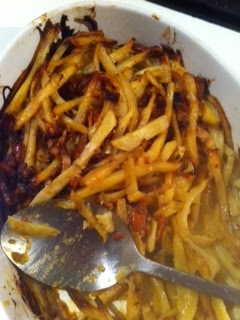
At least the potato resolution is going well - one mammoth cooking session later and we now have Sarah Raven's dauphinoise to look forward to and we have already tucked into a bastardised version of Hugh Fearnley-Whittingstall' Jansson's Temptation. This is made of matchsticks potatoes softened in a pan with onions then stirred with cream and anchovies and cooked for 45 minutes at 200 degrees.  As I didn't have cream or anchovies I used up some left over bacon bits, chorizo and skimmed milk instead and I can say it was delicious even if it wasn't up to the authentic Swedish dish.